
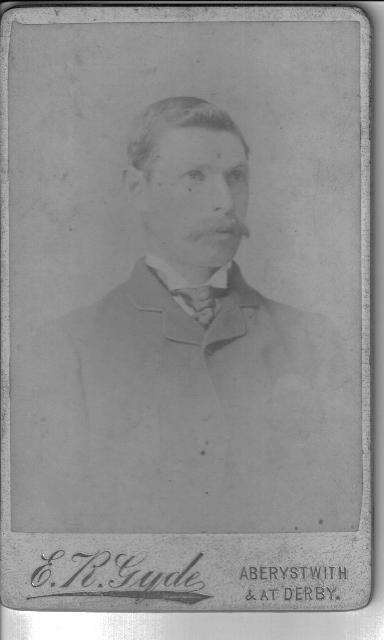
In the upland districts of Montgomeryshire and southern Meirionnydd, the late nineteenth century was an age that demanded toughness and restraint. Men worked long hours in all seasons, living by the hard arithmetic of livestock, rent, weather, and market prices, and measured as much by reputation as by income. Within that world, David Jenkins, eldest son of David and Jane Jenkins of Maescelyn, stands as a representative figure, steady, diligent, and largely unrecorded, until one sudden accident dragged him, briefly and brutally, into public view.
Origins in the Llyfnant Uplands
David Jenkins was born on 24 July 1850 at Cwmrhaiadr, a remote sheep farm deep in the hills beyond the Llyfnant Valley, close to the dramatic waterfall from which the farm took its name. His early life was shaped by the rhythms of hill farming, lambing, shearing, and the annual round of sales and fairs that anchored rural society around Machynlleth. From childhood he would have learned the practical knowledge that mattered most in these communities, stock sense, land sense, and the unglamorous endurance required to keep a farm functioning in an exposed landscape.
As the eldest son, he grew up with the expectation of service to the family unit. His father, also named David Jenkins, moved from Cwmrhaiadr to Maescelyn by the mid 1860s, and remained there for life, establishing the farm as the family’s base and identity. For David the younger, the pattern was typical, years spent as the dependable right hand of his father, doing the labour that kept a substantial upland holding viable.
Work, Change, and the Pressure of the 1880s
By the 1880s the farming world of Mid Wales was under strain. Falling prices, tightening margins, and the harsh logic of the Great Agricultural Depression compelled many families to reassess what could be sustained on the land. For sons who were not positioned to inherit, or for families forced into retrenchment, departure from the home farm became not a choice but a necessity.
It was in this context that David appears to have left Maescelyn and sought work elsewhere, eventually becoming a labourer at Camlan farm in Dinas Mawddwy. The shift is revealing. To move from family farm work to hired labour was a step down in autonomy and status, yet it was also a means of survival, a wage rather than a share in a precarious enterprise. In an era when rural employment could vanish with a poor season or an overdue rent, such a decision speaks less of ambition than of duty, practicality, and the grim realism of a changing countryside.
The Accident at Camlan
David’s death was swift, painful, and shockingly ordinary in its cause. On the afternoon of 13 January 1891, he was transporting manure into a field, a routine agricultural task and one that rarely earns notice until disaster strikes. After unloading the cart, he attempted to take the horse and cart back to the yard. Something startled the animal and it bolted. David, trying to restrain it, tripped and fell, afterwards recalling little of what had happened.
His employer, Humphrey Howells of Camlan, later described seeing the horse and cart racing toward the farmyard with David clinging to the reins, struggling to stop it. At the gateway David disappeared from view, and was found unconscious by the gate. He was taken into the farmhouse, regained consciousness, and tried to account for the incident, but the precise mechanism of the injury remained uncertain. It was believed he had been crushed between gatepost and cart while being dragged, and there was also suspicion that the horse may have stamped on him. What is clear is that the trauma was severe, and that David died in agony at 4.30am the following morning.
At the inquest held on 16 January 1891, Dr Williams of Dinas Mawddwy gave his opinion that the injury had ruptured David’s bladder, an excruciating internal wound and, in the medical conditions of a rural farmhouse, effectively untreatable. David himself told the doctor he believed he had struck something near the gate, but he could not clearly remember what it was.
Character and Reputation
In the short obituaries published after his death, David was described in terms that were valued in rural Wales but rarely celebrated beyond it, quiet, unassuming, honest, and genuine. His employer regarded him as a faithful servant, and the notices also emphasised his deep Methodist piety. These details matter because they show how David was understood by his community. He was not portrayed as a man of public office or striking individuality, but as a person of steady moral standing, the type of worker upon whom farms depended, and whose worth was known most intimately by those who watched him live.
He was buried at Machynlleth on 17 January 1891. In a society where funerals were significant communal events, the return of his body to the market town cemetery reaffirmed both family identity and the cultural geography of belonging. Even in death, the upland labourer was folded back into the story of the wider district.
A Life That Represents an Era
David Jenkins’s life illustrates a hard truth about the Victorian countryside, that the people who sustained its economy often left the faintest documentary trace. He belonged to a generation that bridged two worlds, the older upland system of family farms and labouring tradition, and the newer, less stable reality shaped by depressed prices, changing tenancies, and the necessity of wage labour. His story is not dramatic in the usual sense, but it is deeply human, a life lived through work, faith, and quiet endurance, then ended by the everyday risks that farm labour carried.
And perhaps that is precisely why he deserves to be remembered. The history of rural Wales is not only the history of estates, ministers, or political figures. It is also the story of men like David Jenkins, who did the heavy tasks, asked little, lived modestly, and held themselves to standards of honesty and devotion that shaped the moral texture of their communities.
 Antony David Davies FIoL FRSA FRAS AFRHistS MCMI