
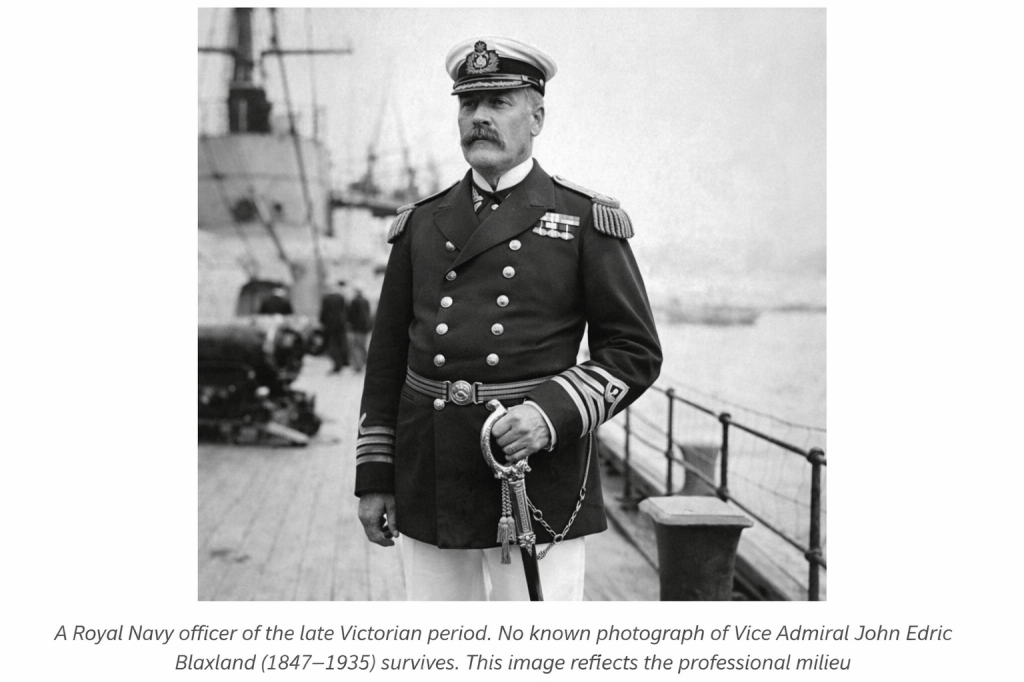
A Victorian Naval Career on a Global Stage
When family history is rooted in place, farming, chapel, and community, the life of a career naval officer can feel almost anomalous, outward-looking, mobile, and shaped by the machinery of empire rather than the rhythms of locality. John Edric Blaxland was precisely that figure, a professional Royal Navy officer whose service carried him into the diplomatic flashpoints and coercive campaigns of late Victorian Britain, and whose later senior appointments placed him within the Navy’s administrative and strategic infrastructure.
Early life and entry into the Royal Navy
John Edric Blaxland was born on 13 May 1847, and entered the Royal Navy as a teenager in January 1861. His naval career began at a moment when Britain’s maritime power was both modernising rapidly and increasingly deployed as an instrument of pressure overseas, particularly in Asia and the eastern Mediterranean.
Action in Japan, 1863–1864
As a young sailor, Blaxland saw service during the bombardments of Kagoshima and Shimonoseki in 1863 and 1864, punitive operations associated with Western demands for access, security, and trade in a Japan then moving towards political transformation. These events matter because they place him, unusually early in his career, in theatres of action that would later be recognised as the front edge of Japan’s transition into a modern imperial state of its own.
Promotion and the Egypt campaign, 1882
Blaxland’s advancement was steady. He reached Sub-Lieutenant in 1867, and Lieutenant in 1870. His next major operational landmark came with the Anglo-Egyptian War of 1882, after which he was promoted to Commander, directly attributed to wartime service. This was the campaign that entrenched Britain’s long occupation of Egypt and underscored how frequently naval officers, as much as soldiers, were used to impose British strategic outcomes.
Zanzibar blockade, 1888
A lesser-known episode, but revealing
A useful addition from wider naval records is his involvement in the 1888 blockade of the Zanzibar littoral, undertaken both in pursuit of anti-slavery enforcement and in response to unrest along the East African coast. During this operation he commanded the gun vessel HMS Griffon.
Though less dramatic than Egypt or Japan, this episode is historically revealing. It illustrates the routine, often uncelebrated work of maritime enforcement that underpinned Britain’s imperial presence in the late nineteenth century.
Captain, Ascension Island, 1896–1900
In 1890 Blaxland was promoted to Captain. Between 1896 and 1900 he was placed in command of Ascension Island, then administered by the Royal Navy. This remote but strategically vital post formed part of Britain’s South Atlantic communications and coaling network. Such an appointment demanded administrative competence and institutional trust rather than public acclaim.
Command of HMS Hood, 1900–1902
From Ascension, his career moved into a more visible fleet command. He served as commanding officer of the pre-dreadnought HMS Hood from 4 September 1900 to 19 April 1902. This appointment anchors his late career firmly within the capital-ship navy of the period, rather than leaving it defined only by promotions and postings.
Retirement and honorary advancement
Blaxland retired from active naval service on 13 May 1902, his fifty-fifth birthday. In retirement he received honorary promotions, becoming Rear Admiral in 1903 and Vice Admiral in 1907, conventional but meaningful acknowledgements of seniority and sustained service.
Marriage and naval continuity
On 25 October 1894 he married Alison Johnstone Roffey, the daughter of a Royal Navy officer. Their son, George Fellowes Blaxland (1907–2004), followed his father into naval service, reaching the rank of Commander and being awarded the OBE in 1944. The pattern is one of continuity rather than exception, service passing from one generation to the next.
Death
John Edric Blaxland died on 20 July 1935, having lived long enough to see the world he had served reshaped by industrial warfare, imperial contraction, and the aftermath of the First World War.
Interpretation
John Edric Blaxland widens the family frame. Where many family narratives remain grounded in land, locality, and the moral economy of rural life, his career illustrates a different nineteenth-century reality, one defined by mobility, professional discipline, and institutional service. His working world was global rather than local, shaped by Admiralty priorities and imperial strategy.
He stands not as a decorative aside, but as part of the real texture of the age, evidence of how a single family could, within a generation, produce farmers, clergy, solicitors, surgeons, and a senior naval officer whose life was spent far from home, yet firmly within the structures of Victorian Britain.
Note on sources
A fuller family context for John Edric Blaxland, alongside related branches and allied lines, is included in my book Old Llyfnant Valley Farming Families, where his naval career appears as part of the wider tapestry of individuals connected to the valley and its extended kinship networks.
 Antony David Davies FIoL FRSA FRAS AFRHistS MCMI