
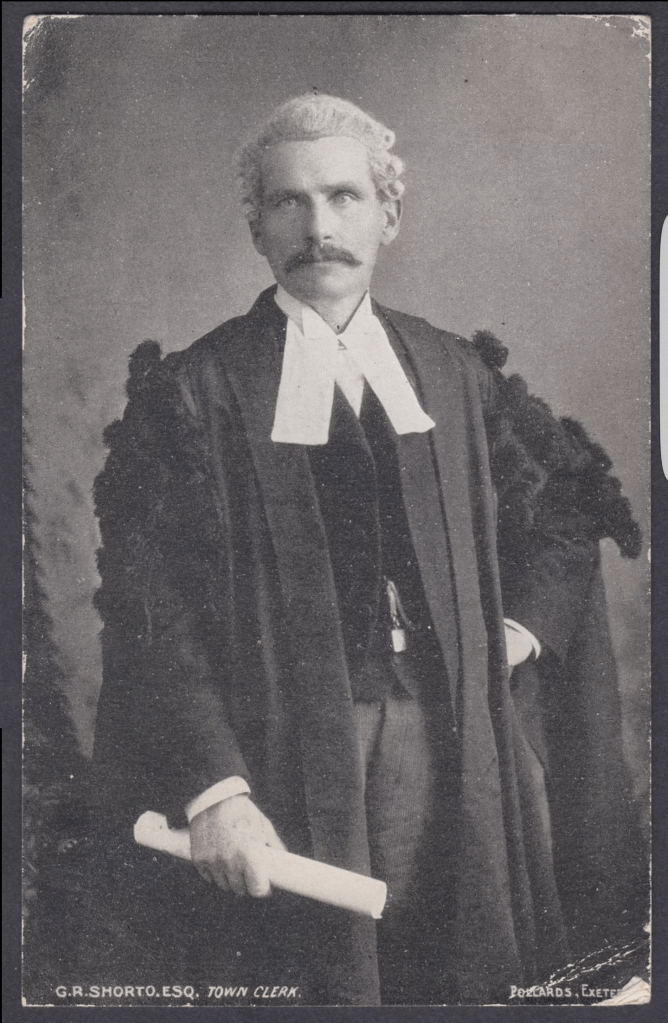
Soldier, Civic Servant, and Architect of Municipal Exeter
George Roberts Shorto occupies a distinctive place in the civic history of Exeter. Soldier, volunteer officer, solicitor, and long-serving Town Clerk, his life charts the emergence of the Victorian professional administrator, shaped by discipline, duty, and an unyielding belief in public service.
Early Life and Formation
Born in Exeter in August 1836 into a family of skilled artisans and parish service, Shorto was educated at St John’s Hospital School, an institution rooted in discipline, Anglican morality, and social aspiration. These formative influences remained constant throughout his life, instilling habits of order, loyalty, and civic responsibility that later defined his career.
A Soldier of Empire
At eighteen, Shorto enlisted in the Rifle Brigade and was soon immersed in the Crimean War. He served through the siege of Sevastopol, endured the hardships that scarred a generation of soldiers, and rose steadily through the non-commissioned ranks to become a Colour Sergeant. His Crimean and Turkish medals were not merely decorations, but symbols of a formative experience that shaped his worldview, reinforcing ideals of hierarchy, endurance, and service to crown and country.
The Citizen-Soldier Ideal
Following his discharge in 1865, Shorto transferred seamlessly into the Volunteer Force, committing over three further decades to military service in Devon. Rising from the ranks to honorary Major, he became one of the county’s most respected Volunteer officers and marksmen. His record of competitive shooting, leadership in drill, and devotion to training exemplified the Victorian ideal of the citizen-soldier, combining martial competence with civic respectability.
Architect of Municipal Exeter
Parallel to his military life, Shorto pursued a demanding legal and administrative career. Entering practice as a solicitor’s clerk, he rose through ability and perseverance rather than patronage, qualifying as a solicitor in 1880. His appointment as Town Clerk of Exeter in 1888 marked a decisive moment in the city’s administrative history. No longer a part-time legal adviser, the Town Clerk became a full-time professional officer, and Shorto became the embodiment of that transformation.
He oversaw contracts, by-laws, civic ceremonies, and major municipal projects, including the administration of the Digby Asylum and the legal frameworks underpinning Exeter’s modernisation. His working style was meticulous and centralised, admired for its rigour, though ultimately damaging to his health.
Civic Identity and Public Life
Beyond the council chamber, Shorto was deeply embedded in Exeter’s public culture. A committed Conservative and Anglican, he lectured on local history, addressed working men’s associations, supported educational initiatives, and promoted organised sport as a moral force. His encyclopaedic knowledge of Exeter’s charters and civic traditions made him the city’s unofficial historical voice at public events and visiting ceremonies.
Character and Reputation
Contemporaries remembered Shorto as genial, witty, and formidable in debate. He combined physical vitality with intellectual authority, equally at ease on the drill ground, the football field, or the public platform. His humour and presence ensured that he was rarely overshadowed, even among Exeter’s civic elite.
Death, Legacy, and Human Cost
Shorto died in August 1905 after years of ill health brought on by relentless overwork. His funeral, conducted with full civic honours at Exeter Cathedral, testified to the esteem in which he was held. Yet the aftermath revealed a more fragile private reality. Despite a substantial career income, his estate proved insolvent, a reminder of the precariousness that could underlie even the most outwardly successful Victorian lives.
No grand monument survives, but his legacy endures in the professional culture he helped shape. George Roberts Shorto stands as a representative figure of late Victorian civic England, disciplined, loyal, intellectually engaged, and ultimately consumed by the very ideal of duty he so fully embodied.
My full-length biography, Duty and Dignity: The Life of George Roberts Shorto (1836–1905), is available on Amazon:
https://amzn.eu/d/1ZzMWer
 Antony David Davies FIoL FRSA FRAS AFRHistS MCMI