
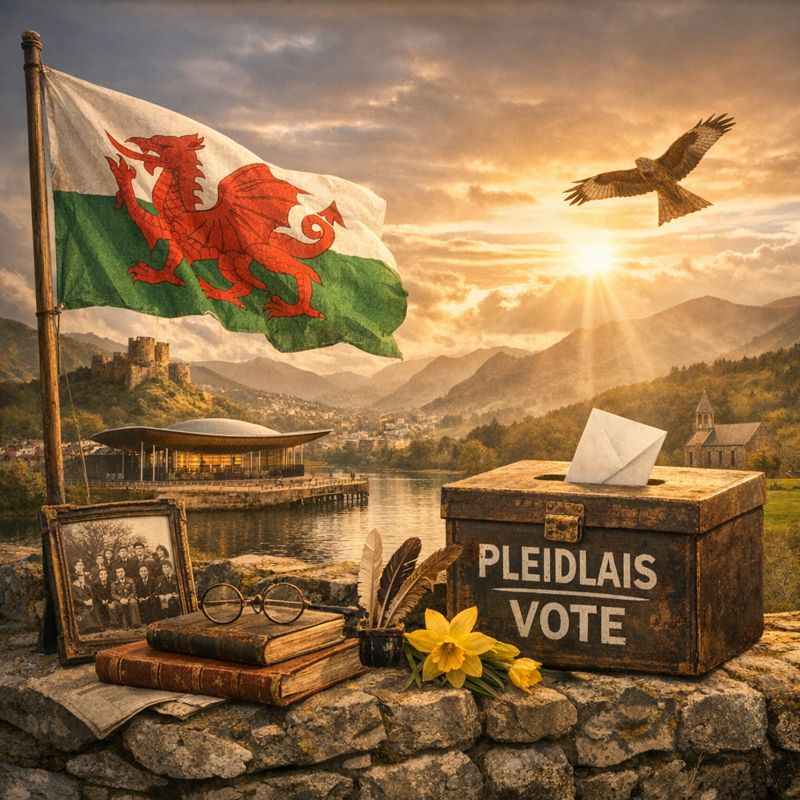
I have spent years living among the dead, listening to the quiet testimony of parish registers, chapel minutes, probate inventories, school logbooks, newspaper columns, fading photographs, and the stubborn, beautiful persistence of family memory. I have written the biographies of ordinary men and women who carried Wales forward without applause, tenant farmers who endured lean winters, Sunday School teachers who formed the moral spine of their communities, craftsmen and clerks who laboured with dignity, and idealists who believed, with a fierce Welsh tenderness, that a small nation could still have a big soul.
And the more I write, the more I understand something simple and profound.
History is not just about preserving what was.
It is about finishing what was started.
The Senedd election is approaching, Thursday, 7 May 2026, and already I have been approached by political organisations, campaigners, and the curious, asking for “insights”, asking what matters in Wales, asking what the mood is, asking what the country needs.
It is a strange experience, being approached not simply as a writer, but as a Welsh voice, as a historian and biographer of rural Wales, as someone whose work is rooted in the long emotional memory of a nation.
Yet perhaps it is not strange at all. Wales is entering a decisive moment, and in decisive moments, people reach for those who can explain the deeper story.
This is mine.
Wales lives in me, wherever I live
I do not currently live in Wales, but Wales has never stopped living in me.
My heart and my family remain there. My people are there, in the soil of Montgomeryshire, in chapel yards and hillside farms, in the moral inheritance of Nonconformity, in the language of landscape, and in the unspoken code of rural communities where reputation still matters, where duty still means something, where a person is judged not by slogans, but by conduct.
I know what Wales is at its best, not because I read it in a pamphlet, but because it was lived, day after day, in the lives of those I have studied and those I descend from.
And I know what Wales suffers from at its worst, the slow erosion of local control, the draining away of young talent, the managerial shrug that tells communities to lower their expectations, the weary fatalism that says Wales must always be a junior partner in its own story.
I have spent long enough studying the past to recognise when a nation is being asked to settle for less than it deserves.
Our ancestors did not fight to be an afterthought
My ancestry includes figures linked, directly and indirectly, to the long arc of Welsh national consciousness, to Cymru Fydd, to the early awakenings that insisted Wales was not a romantic region, but a living nation with its own moral and civic priorities.
Others were shaped by movements determined to place Welsh voices at the heart of Welsh life, in education, in culture, in chapel, in local civic leadership, and in the great struggle to ensure that the child of a farm labourer could possess the same dignity of mind as the child of a professional man.
And sometimes, these things were not abstract ideals. They were practical acts of courage in small places.
In 1907–1908, my own great-uncle helped to establish what our family has long remembered as a “Revolt School” in Llanwrin, rooted in that same Nonconformist conviction that Welsh communities must not simply accept whatever was imposed upon them, but must defend the moral purpose of education, and protect the right of local people to shape the lives of their own children.
That is Wales. That is the historical Wales I know. Not theatrical, not fashionable, not loud, but quietly unbreakable.
They wanted Wales to speak in its own voice, to decide its own priorities, to build its own institutions, to refuse the gentle condescension of outsiders who told us what we were allowed to be.
And if those people could see the Senedd today, they would be chuffed to bits.
Not because it is perfect, it is not, but because it is the first unmistakable sign that Wales can govern Wales.
The Senedd was step one.
Step two is what we do with it.
The Senedd must become the instrument of Welsh purpose
Devolution was never meant to be decorative. It was never meant to be a regional management layer administering scarcity while Westminster kept the real levers of power.
It was meant to be a national institution, building a Wales shaped by Welsh needs, Welsh culture, Welsh geography, and Welsh priorities.
That is why this election matters. It is not just another contest between parties, not just another round of tribal arguments, not just another attempt to frighten voters into accepting “the least worst option”.
It is historic for another reason too. The Senedd is expanding, it is growing to 96 Members, elected through a reformed system designed to strengthen Welsh democracy and deepen Welsh accountability.
We are being given a bigger vessel.
Now we must decide what we fill it with.
Wales needs leadership that puts Wales first
I have no interest in empty nationalism. Wales does not need theatrical rage, nor resentful posturing, nor a politics built on permanent grievance.
Wales needs a quiet revolution of competence, confidence, and purpose.
It needs leadership that understands that Wales is not one place. We are not just Cardiff and the Valleys. We are Gwynedd and Gwent, Ceredigion and Caerphilly, Anglesey and Abergavenny, Pembrokeshire and Powys. We are post-industrial communities carrying the scars of abandonment, and rural communities carrying the burden of invisibility.
Wales is a nation of multiple cultures and ways of life, and any party that claims to speak for Wales must respect them all.
That is why, for me, the argument for Plaid Cymru is not romantic, it is practical.
Wales must be run for the benefit of Wales, by people who put Wales first, and who genuinely know the land, the cultures, the communities, and the pressures that shape daily life here.
Not people managing Wales as a footnote.
Not people treating Wales as a brand.
Not people who discover their “Welshness” only when the cameras arrive.
The moral argument, Plaid Cymru as the modern heir to Welsh aspiration
Plaid Cymru is not perfect. No party is.
But Plaid Cymru remains, at its core, the clearest political expression of a simple principle, that Wales is a country with the right to shape its own future, and that Welsh life should not be perpetually subordinate to priorities set elsewhere.
As a historian, I am always alert to continuity.
When I look at the long line of Welsh idealism, the chapel-centred moral seriousness, the insistence on education, the struggle for dignity, the hunger for local agency, the belief that communities matter, I see an inheritance that makes sense of Plaid Cymru’s existence.
Plaid does not have to invent Welsh purpose.
It inherits it.
And that matters, because Wales does not need another hollow managerial project. Wales needs a party that believes Wales has a destiny beyond “getting by”.
A nation that forgets itself will always be governed by other people’s priorities.
This is not about leaving the past behind, it is about fulfilling it
When you write biography, you learn the power of unfinished stories.
You learn how many lives were lived with aspirations constrained by circumstance, by power, by poverty, by geography, by class, by the slow drain of opportunity.
They did not always get the Wales they deserved.
But they left us clues. They left us values. They left us a moral compass.
And we dishonour them if we treat Wales as something to be managed rather than something to be built.
A Plaid Cymru victory in this moment would not simply be a political switch. It would be a statement, perhaps the first truly confident statement of the devolution era, that Wales intends to govern itself with ambition, not apology.
It would say, to rural Wales and post-industrial Wales alike, that this country is not an administrative region, but a living nation with the right to dream again.
The emotional truth, Wales is not an abstract idea
There is a word every Welsh person understands, whether we speak the language fluently or not.
Hiraeth.
It is more than nostalgia. It is longing, belonging, ache, fidelity. It is the knowledge that you are part of something older than your own life, and that you have responsibilities to it.
I feel that as a biographer, because I have looked my ancestors in the eye through the written record. I have watched them struggle for self-respect, for education, for fairness, for community survival. I have watched them cling to the belief that local voices matter.
And I feel it as a Welshman, because Wales is not a concept to me. It is a place of people and fields, of slate and coal, of hymns and hardship, of stubborn courage and deep humour, of quiet pride and fierce decency.
So yes, my heart remains there, and so does my vote in spirit, and so does my loyalty.
A final word to those who feel Wales has grown tired
I know some people are weary. I know some are cynical. I know some have stopped believing that elections change anything.
I understand that feeling.
But history teaches something else. It teaches that moments arrive when a people must choose whether they still believe in themselves.
This is one of those moments.
The Senedd was the first step, the proof that Wales could have the machinery of self-government.
Now we must decide whether that machinery will serve Wales boldly, or merely exist.
If we want a Wales that honours its communities, respects its cultures, and fulfils the long aspiration of those who fought for Welsh voice in Welsh life, then we must choose the party most likely to place Wales at the centre of its own story.
For me, that party is Plaid Cymru.
Not because it flatters us.
Not because it promises miracles.
But because it begins from the one premise every nation must eventually embrace if it is to thrive,
That Wales must be run for Wales.
And if our ancestors could see what is possible now, they would not want us to hesitate. They would want us to finish the work.
On 7 May 2026, Wales can make history.
And for the sake of those who came before us, and those who will come after, I believe it must.
Vote Plaid Cymru.
 Antony David Davies FIoL FRSA FRAS AFRHistS MCMI