
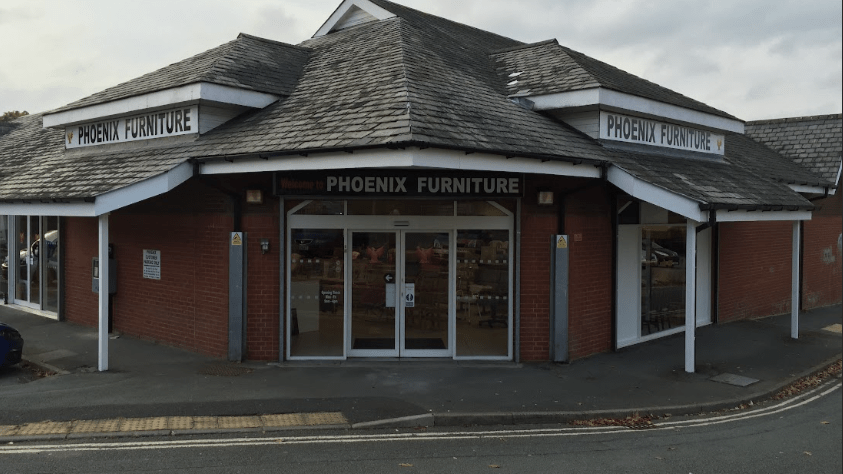
Between 2008 and 2017, I helped steer Phoenix Community Furniture Scheme through its most turbulent decade, from post-recession ambition to austerity-Between 2008 and 2017, I helped steer Phoenix Community Furniture Scheme through its most turbulent decade – years that took the organisation from post‑recession ambition to austerity‑era survival, and then into a period of renewal that ultimately revealed the limits of vision without alignment.
With distance, that decade has become one of the most instructive chapters of my career. It taught me how progress is made, how easily it can stall, and how leadership often requires standing firm long before an organisation is ready to follow.
Crisis and Collapse
When I joined Phoenix in 2008, the organisation was thriving. A new headquarters in the historic Pryce Jones Building in Newtown, a recently opened branch in Llandrindod Wells, and ambitious reuse and recycling projects positioned it as a model of community enterprise in mid‑Wales.
Within two years, that optimism evaporated.
By 2010, austerity had hit hard. Grants disappeared, contracts were cut, and small charities like Phoenix were left dangerously exposed. Projects collapsed, staff were laid off, and the senior management team departed. Survival – not growth – became the overriding concern.
Amid this turmoil, I was asked to step up as Store Manager of the Llandrindod Wells branch, a site with no budget, no reserves, and a leaking, unheated depot.
Holding the Line
What we lacked in resources, we made up for in belief.
I built a volunteer team who collectively gave the equivalent of full‑time hours without pay. Together, we created a dignified, welcoming space where families on low incomes could access affordable, good‑quality furniture at a time when many were under extreme pressure.
Against all expectations, our small branch outperformed the flagship Newtown store.
It proved something I have never forgotten: community impact is not primarily about buildings or budgets, but about people, purpose, and shared resolve.
Yet by early 2013, funding pressures became impossible to ignore. The Llandrindod Wells store closed in March, and I was relocated to Newtown as Business Development Manager. It marked the beginning of a new phase—both for Phoenix and for me.
Rebuilding and Modernising
Between 2013 and 2015, I led one of the most transformative periods in Phoenix’s history.
Drawing on my background in governance, strategy, and community engagement, I focused on stabilising and modernising the organisation. Over the next two years, I secured more than £300,000 in grants and service‑level agreements, helping Phoenix recover after years of contraction and uncertainty.
At the same time, I pushed for professionalisation and visibility. We replaced outdated systems, introduced laptops for flexible working, rebuilt the website, revitalised social media, and grew Phoenix’s Facebook following to over 500 – making it one of the most visible reuse charities in Wales at the time.
But perhaps the most significant change was cultural.
A Bilingual, Inclusive Vision
One of my earliest successful bids funded a project to make Phoenix fully bilingual in Welsh and English.
In 2013-14, this was far from standard practice. The Welsh Language (Wales) Measure 2011 was still relatively new, and the statutory Welsh Language Standards had not yet been applied to most third‑sector organisations. For a small reuse charity in rural mid‑Wales to commit to full bilingual provision was unusual – even bold.
For me, it was non‑negotiable.
Inclusion is not symbolic. It is structural. Equal access to services, information, and dignity must be built into an organisation’s everyday operations. While the bilingual website went live, I encountered resistance when pushing for forms, leaflets, and printed materials to follow.
That tension became one of the defining lessons of my career: leadership sometimes means standing firm before the world – or the organisation – is ready to catch up.
Vision Meets Resistance
By 2015, a deeper shift was underway.
When the Pryce Jones building was put up for sale, anxiety set in about Phoenix’s future location. I proposed something deliberately ambitious: relocating to an abandoned supermarket, a spacious, accessible site ideally suited to Phoenix’s operational needs and future growth.
The idea gained traction, and the move ultimately went ahead. Yet my role in shaping that vision was quietly erased, and credit placed elsewhere.
What mattered was not the loss of recognition, but what it revealed. The organisational culture was changing. Innovation was giving way to insecurity. Politics and self‑protection were replacing confidence and collective ambition.
Throughout 2016, that insecurity hardened. My influence and decision‑making power were gradually – and at times deliberately – eroded. The more I pushed for alignment, clarity, and long‑term thinking, the more resistance I encountered. It became clear that the organisation was no longer willing, or able, to sustain the level of ambition that renewal required.
By January 2017, I made the decision to leave. It was the right moment. I had taken Phoenix as far as I could within the limits of the culture that had emerged.
After the Fire Faded
Today, Phoenix continues to exist, but on a far smaller, survival‑focused footing. Income and visibility are significantly reduced from their peak. The once‑visionary digital presence has gone. The inclusive, future‑facing ambition has faded.
This is not a story of individual failure. It is a familiar third‑sector pattern.
Across the UK, community charities carried an enormous share of social welfare during austerity, often on goodwill alone. Many had the passion to serve, but not the power – or the internal confidence – to scale.
The Enduring Lesson
I remain proud of what we achieved at Phoenix: the volunteers who gave everything, the families who found stability and dignity, and the proof that community enterprise can thrive even in the harshest conditions.
Success is not always measured by longevity or expansion. Sometimes it is measured by standing firm when the world is falling apart, and by planting ideas whose time has not yet come.
That rediscovered 2014 AGM report reminded me of something essential: community regeneration begins with empowering people – and that includes empowering identity, voice, and vision.
Purpose gives work its meaning. Progress gives it momentum. Leadership lives in the space between the two, and in recognising when the limits of power have been reached.
After the Fire Faded
Today, Phoenix continues to exist, but on a far smaller, survival-focused footing. Income and visibility are significantly reduced from their peak. The once-visionary digital presence has gone. The inclusive, future-facing ambition has faded.
This is not a story of individual failure. It is a familiar third-sector pattern.
Across the UK, community charities carried an enormous share of social welfare during austerity, often on goodwill alone. Many had the passion to serve, but not the power, or the internal confidence, to scale.
The Enduring Lesson
I remain proud of what we achieved at Phoenix: the volunteers who gave everything, the families who found stability and dignity, and the proof that community enterprise can thrive even in the harshest conditions.
Success is not always measured by longevity or expansion. Sometimes it is measured by standing firm when the world is falling apart, and by planting ideas whose time has not yet come.
That 2014 AGM report, rediscovered years later, reminded me of something essential: community regeneration begins with empowering people, and that includes empowering identity, voice, and vision.
Purpose gives work its meaning. Progress gives it momentum. Leadership lives in the space between the two, and in recognising when the limits of power have been read.
 Antony David Davies FIoL FRSA FRAS AFRHistS MCMI