
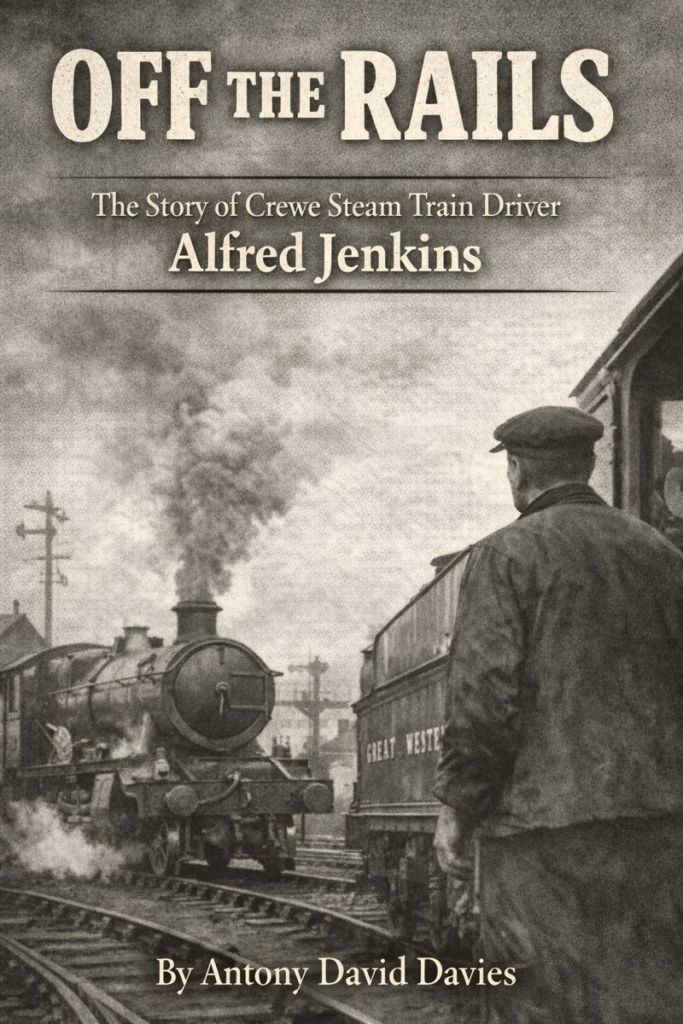
Off the Rails: The Story of Crewe Steam Train Driver Alfred Jenkins began not as a publishing project but as an act of recovery, an attempt to give structure and permanence to a life that had been lived with discipline, endurance, and quiet dignity, and then almost lost to time.
Alfred Jenkins (1882–1956) was my great-grandfather. He spent forty-five years on the footplate of the Great Western Railway, working out of Crewe’s Gresty shed in a town dominated by the rival LNWR. His career took him from teenage greaser to engineman, spanning the Edwardian peak of steam, two world wars, industrial unrest, and the long twilight of the interwar railway. He was not famous. He did not write memoirs. He left no public legacy. And yet, like thousands of men of his generation, he carried on his shoulders a system on which modern Britain depended.
This book is my attempt to take that life seriously.
Not a Technical Railway Book
This is not a handbook of locomotives, nor a catalogue of routes and classes. Those histories already exist and they do their work well. Off the Rails is instead concerned with people, with labour as lived experience, with the moral and social worlds that sustained the railway long before heritage lines and nostalgia intervened.
The steam railway was not simply an employer. It was a total institution. It regulated behaviour, health, family life, respectability, and reputation. Men were examined, tested, disciplined, and recorded. Their wives carried invisible burdens, managing households around night turns, lodging duties, strikes, and wartime exhaustion. Their children grew up knowing that their father’s conduct on the footplate shaped the family’s standing in the street.
Alfred’s service record, medical examinations, disciplinary notations, and promotion history reveal a world of relentless scrutiny. One lapse at a signal could end a career. One failed eyesight test could undo decades of faithful service. That Alfred remained on the footplate until 1942, passing every medical examination into his late fifties, is itself a quiet testament to endurance.
Crewe as a Moral Landscape
Crewe was not just a town of workshops and sheds. It was a moral environment, shaped by discipline, mutual surveillance, and pride in skilled labour. To be a driver was to hold a position of trust. To be a driver’s wife was to shoulder responsibility for domestic order and respectability. In writing this book, I became increasingly aware that Alfred’s life cannot be separated from that of his wife Alice, whose unpaid labour made his career possible.
This is therefore as much a social history of railway marriage, household economy, and community as it is a biography. The railway ran on coal and steam, but it was sustained by women’s labour, by routines of care, thrift, and emotional resilience that rarely appear in official records.
Why Recover This Story Now?
Much of the Jenkins family archive was lost after my great-grandmother’s death in 1959. What survived did so by chance. When those materials resurfaced decades later, they revealed not drama but structure, a life governed by duty, repetition, and responsibility.
That is precisely why it matters.
British history too often privileges the exceptional, the loud, or the powerful. Yet modern Britain was built by men and women whose lives were defined not by rebellion or notoriety, but by reliability. Alfred Jenkins’s story is not extraordinary because it was unusual, but because it was typical, and typical lives are the hardest to recover once living memory fades.
Off the Rails is offered as a small act of restitution. It restores one railwayman, and one railway family, to the historical record, not as an anecdote, but as evidence.
A Continuing Thread
Readers familiar with my earlier work will recognise a continuity here. Whether writing about Welsh upland farmers, Nonconformist communities, or Victorian institutions, my concern has always been with how authority is lived, how discipline is internalised, and how ordinary people navigated systems far larger than themselves.
The railway was one such system. Alfred Jenkins lived within it for nearly half a century. This book is my attempt to understand that world on its own terms, and to honour a generation whose labour made modern Britain function, often without thanks, and now, increasingly, without memory.
Off the Rails: The Story of Crewe Steam Train Driver Alfred Jenkins is now available.
 Antony David Davies FIoL FRSA FRAS AFRHistS MCMI