
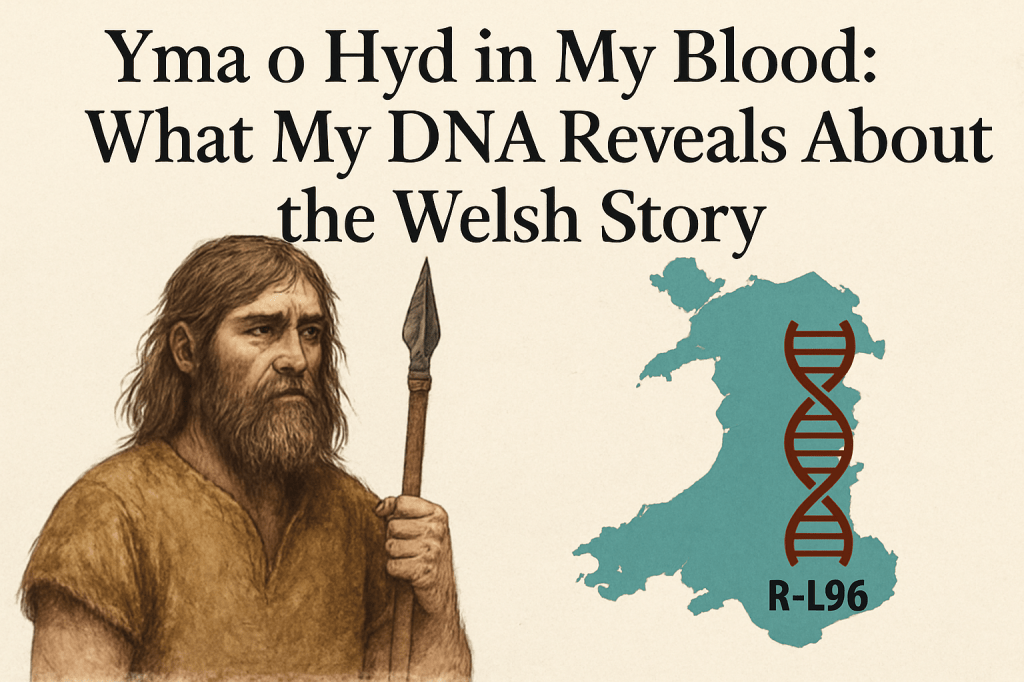
When we explore family history, we often begin with parish registers, gravestones, and sepia photographs. Yet DNA now allows us to go far deeper, reaching back not hundreds but thousands of years. My own paternal line — the Davies men of Montgomeryshire — has recently been confirmed as belonging to a branch called R-L96.
This may sound like a jumble of letters and numbers, but it carries a meaning as old as Wales itself.
The Welsh Male Majority
Most men in Wales — close to 9 out of 10 — belong to a Y-DNA haplogroup called R1b. This lineage arrived here in the Bronze Age, about 4,000 years ago, carried by farming and warrior peoples who brought metal tools, new ways of living, and new languages. Over the centuries, one branch of R1b — known as L21 — became dominant across Ireland, Scotland, and Wales. It is often described as the Celtic signature of the Isles.
A Rare Survivor: R-L96
But my family line does not belong to L21. Instead, our DNA traces back to R-L96, an older, rarer cousin branch that split away thousands of years before L21 spread so widely. In Wales today, R-L96 is exceptionally uncommon — far fewer than 1% of men carry it.
That means my direct paternal line is not part of the majority story. It is a survivor, an echo of some of the earliest men ever to settle in Britain. Somehow, across four millennia, this lineage endured — in small numbers, in upland farms, tucked away from the great tides of conquest and empire.
Rooted in Montgomeryshire
For centuries, my Davies ancestors lived in the hills around Llanwrin and Machynlleth — an area defined by sheep farms, drovers’ roads, chapels, and the stories of Glyndŵr. These hills have seen Romans, Saxons, Normans, and English kings come and go. And yet, through it all, an unbroken line of fathers quietly passed on the same Y-chromosome.
When I walk the fields of Caeadda or look up to Esgair Llewelyn, I know I am treading ground where my bloodline has stood since long before there was such a thing as Wales.
Older Than Nations
To put the timescale in perspective:
- When the first men of R-L96 reached these shores, Stonehenge was still a living monument.
- The Welsh language did not yet exist.
- Christianity was thousands of years away.
- The idea of “Wales” itself was unimaginable.
And yet, from that distant age to today, this DNA survived — carried in the men of my family who lived, worked, farmed, prayed, and died in the same valleys of mid-Wales.
A Symbol of Endurance
For me, this discovery is not just scientific trivia. It is profoundly symbolic. Family legend says one of our ancestors once gave shelter to Llywelyn the Last on his final journey. Whether true or not, the idea feels fitting: a family line that has stayed put, endured, and survived, while armies and empires rose and fell.
It is easy to think of Wales as fragile — a small nation overshadowed by larger neighbours. But my DNA is living proof of something else: continuity against all odds.
In that sense, it carries the same message as Dafydd Iwan’s song Yma o Hyd: “Er gwaetha pawb a phopeth, rydyn ni yma o hyd” — in spite of everyone and everything, we are still here.
More Than a Code
My DNA is not “big” in terms of numbers. It is rare. But it is big in meaning. It shows that Wales is not a recent idea, nor a fragile invention. It is rooted in bloodlines, landscapes, and communities that have endured for millennia.
When I say my family has lived in Montgomeryshire for centuries, that is history.
When I say our DNA has been here for 4,000 years, that is legacy.
And it is still here — living, breathing, and speaking for itself.
 Antony David Davies FIoL FRSA FRAS AFRHistS MCMI